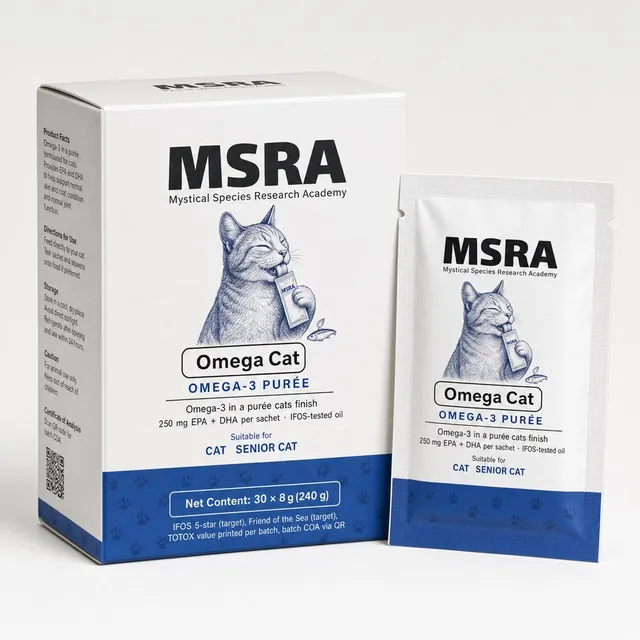
Omega Cat
Omega-3 for skin and coat, in a purée cats finish
Marine EPA and DHA in a single-serve, nitrogen-flushed tuna purée. The omega-3 content is printed on the carton, and each batch comes with a freshness certificate.
- Format
- Omega-3 purée
- Pack
- 30 sachets × 8 g
- Price
- Announced at launch
No payment now. Join the waitlist and we email you once, when it is ready to ship.
Why we made it
Owners buy fish oil for their cat's skin and coat, then find the cat will not touch food with oil on it. Pump bottles leak and make a mess, and once opened the oil oxidises: owners describe brown residue floating in oil they suspect has gone bad. Lickable alternatives solve the taste problem, but the leading one declares no EPA or DHA at all, so owners cannot tell what their cat is getting. And when we checked, no pet fish-oil brand published oxidation values or a batch certificate of analysis.
Omega Cat puts a declared amount of marine EPA and DHA into a tuna purée cats lick willingly, sealed in a nitrogen-flushed single-serve sachet, so there is no open bottle to go rancid. The oil is a re-esterified triglyceride concentrate, the form with the highest absorption among the concentrates compared in a controlled study. We matched the dose to the daily EPA and DHA intake in the positive controlled cat trials, added vitamin E to protect the oil in the body, and link a freshness certificate to every batch.
How we researched it
- Owner-problem phase: retailer reviews, owner forums and competitor label panels. The top complaints were refusal, leaking pumps and rancid oil. We checked every pet fish-oil brand we could find for published oxidation data or batch certificates and found none.
- Literature pass: our AI-powered research system ran 60 searches and drew on 51 PubMed-indexed papers; our team reviewed every claim. Finding: cats have no established safe upper limit for EPA and DHA. The often-quoted figure is a dog value, so we set our own.
- A second, independent research run proposed a lower, DHA-led dose. We compared both against the published cat trials, kept the dose that matches their exposure, and added a smaller serving for small cats to protect the safety margin.
- Rejected: plant omega-3 such as flax or chia (cats convert it poorly to DHA), DHA-only algal oil (less EPA), ethyl-ester concentrates (lower absorption), and free vitamin C, which can speed oxidation alongside the iron in tuna.
What's inside
- Marine fish oil concentrate (re-esterified triglyceride)
- Source of EPA and DHA, in the concentrate form with the highest measured absorption.
- Tuna
- Carrier and flavour: a purée cats lick willingly, held to a strict mercury specification.
- Vitamin E
- Dosed to the feline guideline for added fish oil, protecting the omega-3 inside the body.
- Mixed tocopherols, rosemary extract and ascorbyl palmitate
- Antioxidants in the oil that slow rancidity in the sachet.
- Trisodium citrate
- Binds the iron from tuna that would otherwise speed oxidation of the oil.
The evidence
- In a crossover trial in 10 healthy adult cats (and 12 dogs), 84 days of a PUFA-rich oil blend improved coat flexibility, brightness and skin condition scores; hair breaking force rose 5.79% in cats, and serum triglycerides rose 13.16%. An oil blend, not our sachet. [1]
- In 24 cats fed fish-oil or algal-oil foods at matched DHA levels over three 5-week periods, serum DHA rose similarly, but serum EPA was higher with fish oil. Cats; complete foods, not our sachet. [2]
- In 72 people given about 3.3 g of EPA plus DHA daily for 2 weeks, re-esterified triglyceride oil showed 124% bioavailability relative to natural fish oil, ethyl esters 73%. Studied in humans, not cats. [3]
- In 8 healthy cats given purified EPA and DHA daily for 2 months, plasma EPA and DHA rose significantly with no change in bleeding time or platelet aggregation. Cats; purified fatty acids, not our sachet. [4]
Where the evidence stops
- Our dose is matched to published cat trials, but those trials used complete diets or oil blends. Omega Cat itself has not been tested in cats yet.
- Visible coat changes take 8 to 12 weeks. We sell Omega Cat for skin and coat only; other claims would need a higher intake or a complete diet.
- Heat sterilisation could reduce omega-3 or raise oxidation in the sachet. Our lab is measuring both in the finished product before launch.
How to use it
Once a day from the sachet or over food; use straight after opening. Small cats need less. Ask your vet first if your cat takes anticoagulants, NSAIDs or aspirin.
Studies cited
- [1]Cai X, Xiong C, et al. 2026. PUFA-rich oil supplement improves hair condition of cats and dogs.Open veterinary journal · PubMed 42376104 · Free full text
- [2]Motsinger LA, Kalmbach CR, et al. 2025. Effects of algal oil as an alternative to fish oil in feline foods on serum concentrations of eicosapentaenoic acid and docosahexaenoic acid.Journal of animal science · PubMed 40923230 · Free full text
- [3]Dyerberg J, Madsen P, et al. 2010. Bioavailability of marine n-3 fatty acid formulations.Prostaglandins, leukotrienes, and essential fatty acids · PubMed 20638827
- [4]Bright JM, Sullivan PS, et al. 1994. The effects of n-3 fatty acid supplementation on bleeding time, plasma fatty acid composition, and in vitro platelet aggregation in cats.Journal of veterinary internal medicine · PubMed 7983618
These studies tested ingredients or similar products, often in other species, not this finished product.
Omega Cat
Join the waitlist. No payment now, one email when it is ready to ship.