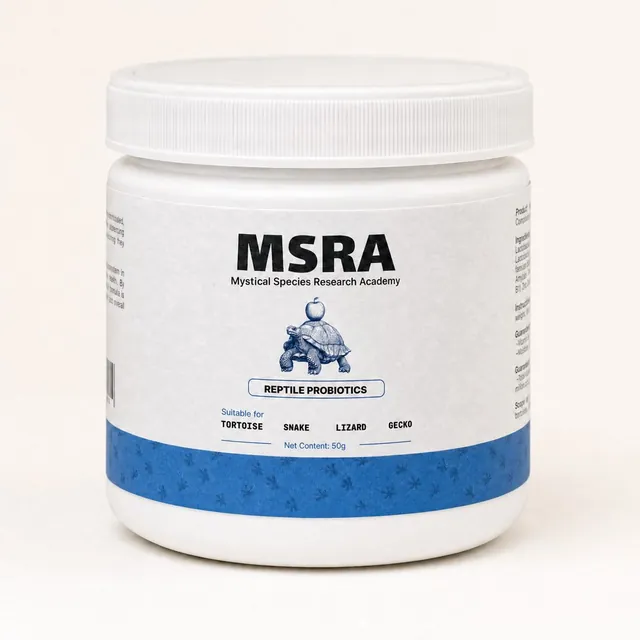
Reptile Probiotics
Multi-strain live cultures for reptiles, dosed by body weight
Five live microorganisms plus vitamin B1 in a powder dosed by your reptile's body weight, with an honest account of what reptile research does and does not show.
- Format
- Probiotic powder
- Pack
- 50 g jar
- Price
- Announced at launch
No payment now. Join the waitlist and we email you once, when it is ready to ship.
Why we made it
Keepers reach for a probiotic after a deworming or veterinary treatment course, after brumation or hibernation, or when a new animal arrives. The products on the shelf give them little to go on. Most tell a 20 g gecko and a 15 kg sulcata tortoise to take the same serving. Some are dosed through drinking water, which reptiles drink little of and which, warm in a vivarium, grows bacteria of its own. Because nothing on the label tells them what they are getting, some keepers give human probiotics off-label instead.
Our research found that the one long-term positive reptile probiotic trial used a multi-strain blend sharing three of our organisms, so we keep the blend multi-strain. It is dosed by body weight, because a gecko and a giant tortoise do not need the same amount. It carries vitamin B1 for fish-fed reptiles, since some fish contain an enzyme that destroys it. And we say plainly where the evidence stops: almost all of it comes from turtles.
How we researched it
- This product was already selling, so we asked a different question: what evidence exists for the category, and does our dosing make sense? Most of 119 searches went to keeper forums, label panels and patents, because the science is thin.
- Our AI-powered research system searched and cross-checked the literature, and our team reviewed every finding. Seven in-vivo records exist in total: six in farmed aquatic or semi-aquatic turtles, one an uncontrolled iguana report. No controlled trial exists in any lizard, snake, gecko or land tortoise.
- We kept the null and negative results in view: growth did not change in yellow-bellied sliders or soft-shelled turtles, and one Bacillus subtilis strain given alone reduced gut villus height in musk turtles.
- A label-by-label review of six competing reptile probiotics found only one dosing by body weight, and one delivering everything through drinking water. Every reptile trial gave probiotics in food, so that is how we tell keepers to use ours.
What's inside
- Bacillus subtilis
- Spore-forming culture that keeps well in storage; improved weight gain and survival in a 216-turtle trial.
- Lactobacillus acidophilus and Lactobacillus casei
- Lactic acid bacteria; L. acidophilus was part of the blend that raised musk turtle growth.
- Enterococcus faecium
- Improved gut-lining structure and immune markers in soft-shelled turtles, though growth did not change.
- Bifidobacterium bifidum
- Part of the multi-strain blend linked to better growth and shell minerals in musk turtles.
- Vitamin B1 (thiamine)
- For fish-fed reptiles: some fish contain thiaminase, an enzyme that destroys vitamin B1.
- Amylase and zinc
- A starch-digesting enzyme and a trace mineral; no reptile study tests either, so we claim nothing for them.
The evidence
- In a 52-week trial in 30 musk turtles, a multi-strain probiotic including L. acidophilus, B. bifidum and E. faecium raised weight gain to 7.22 g versus 5.63 g in controls (P=0.045) and increased shell calcium and phosphorus. Turtles; a different blend. [1]
- In 216 juvenile Reeves' turtles fed for up to 120 days, Bacillus subtilis improved weight gain rate and survival and increased intestinal villus height and width versus a control diet. Turtles; a single-strain feed additive, not our blend. [2]
- In 24 juvenile soft-shelled turtles over 6 weeks, Enterococcus faecium did not change growth, but goblet cells rose 1.5-fold, villus measures and intestinal IgA increased, and Aeromonas fell. Turtles; a single strain, not our blend. [3]
- Seven alligators fed only gizzard shad, a thiaminase-rich fish, fell to 25-50% of their starting blood and muscle thiamine over 6-12 months; three died, and two given thiamine recovered normal levels. Alligators; vitamin B1, not probiotics. [4]
Where the evidence stops
- Every controlled reptile probiotic trial we found was in aquatic or semi-aquatic turtles. Use in lizards, snakes, geckos and land tortoises is extrapolation.
- Results are mixed, and Lactobacillus and Bifidobacterium are not core reptile gut bacteria, so expect passing support rather than permanent colonisation.
- This product has not itself been tested in reptiles. It is not a treatment for parasites or infection; follow your vet's advice.
How to use it
Dust feeder insects, sprinkle on lightly misted greens, or roll thawed prey in it while damp. Dose by body weight per the pack. Never add to drinking or soaking water.
Studies cited
- [1]Rawski M, Kierończyk B, et al. 2016. Dietary Probiotics Affect Gastrointestinal Microbiota, Histological Structure and Shell Mineralization in Turtles.PloS one · PubMed 26828367 · Free full text
- [2]Luo M, Feng G, et al. 2022. Role of Clostridium butyricum, Bacillus subtilis, and algae-sourced β-1,3 glucan on health in grass turtle.Fish & shellfish immunology · PubMed 36182025
- [3]Zhang Y, Lu Y, et al. 2025. Effects of Dietary Supplement of Probiotic Enterococcus faecium on Intestinal Microbiota and Barrier Structure, Immune Function, and Antioxidant Capacity of Soft-Shelled Turtle Pelodiscus sinensis.Aquaculture nutrition · PubMed 39958705 · Free full text
- [4]Ross JP, Honeyfield DC, et al. 2009. Gizzard shad thiaminase activity and its effect on the thiamine status of captive American alligators Alligator mississippiensis.Journal of aquatic animal health · PubMed 20218498
These studies tested ingredients or similar products, often in other species, not this finished product.
Reptile Probiotics
Join the waitlist. No payment now, one email when it is ready to ship.