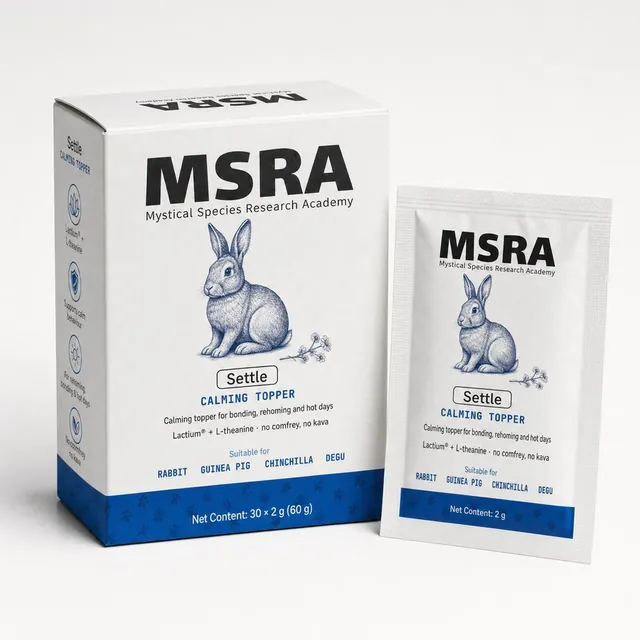
Settle
Herb-free calm for bonding, new homes and travel
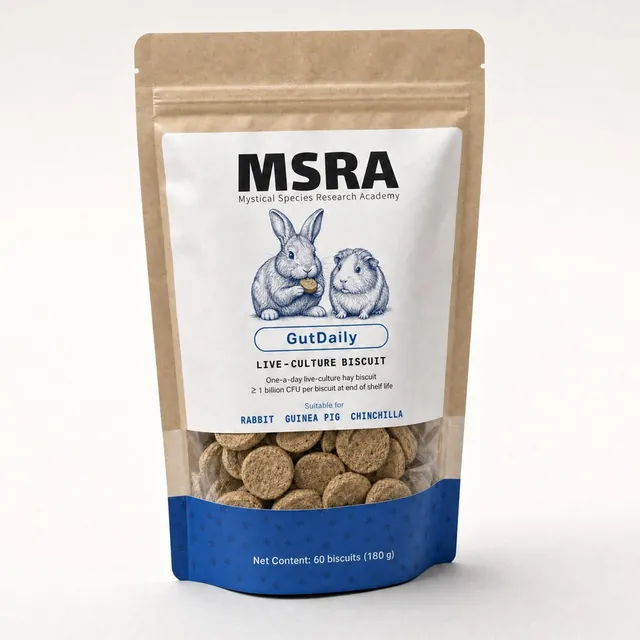
A hay-flour topper with alpha-casozepine and L-tryptophan for rabbits, guinea pigs and chinchillas facing change. Herb-free, because common calming herbs relax gut muscle.
- Format
- Calming topper (hay-flour granules)
- Pack
- 30 sachets × 2 g
- Price
- Announced at launch
No payment now. Join the waitlist and we email you once, when it is ready to ship.
Why we made it
For rabbit and guinea pig owners, stress is not just a behaviour problem. Bonding a second rabbit, moving house, recovering from neutering or travelling can put a small herbivore off its food, and owners know a rabbit that stops eating needs a vet fast. A failed bonding can end in an emergency vet visit. What is on offer is mostly herb biscuits with no dose on the pack, some containing comfrey or kava. Loose herbs get refused: one owner sprinkled chamomile on the hay and her rabbit refused the whole pile.
We wanted a calming product that respects how a rabbit's gut works. Settle uses alpha-casozepine, the same milk-derived calming peptide as our cat and bird lines, with L-tryptophan, on a carrier of hay flour the animal already recognises. Each sachet is pre-dosed, so owners know what every animal gets, and it is herb-free by design. We are open that this is an extrapolation: the dose is scaled from rodent studies, and no one has yet tested it in rabbits.
How we researched it
- Owner-problem phase: rabbit owner forums, retailer listings and reviews in the US, UK and EU. Owners feared a stressed animal going off its food more than the stress itself. Two of three category leaders contained comfrey and one contained kava, both linked to liver harm.
- Literature pass: our AI-powered research system ran 65 searches and cross-checked 54 PubMed-indexed papers; our team reviewed each one. No study of alpha-casozepine exists in any rabbit, guinea pig or chinchilla, so the dose is scaled by body weight from rat studies.
- A second, stricter pass removed every herb. Chamomile and a valerian species relaxed isolated rabbit gut tissue, and lemon balm depressed gut contractions in sheep tissue. Slowing the hindgut is exactly what a rabbit should avoid.
- A second, independent research run flagged that digesting milk protein can release opioid-like peptides that slow gut transit in lab models. It is a class risk, not shown at our dose, so our research calls for a gut-tolerance study before launch.
What's inside
- Alpha-casozepine (milk protein hydrolysate)
- Milk-derived calming peptide; in rodents it calmed without impairing movement, which matters for a prey animal.
- L-tryptophan
- Amino acid the body uses to make serotonin, which also supports normal gut movement in rabbits.
- Timothy or meadow hay flour
- Familiar, high-fibre carrier the animal already eats, ground coarse enough to resist sorting.
- Lucerne meal and apple pomace
- Natural flavour so the granules taste like food, not medicine.
- Acacia gum
- Light coating that helps granules cling to damp greens so they are not picked out.
The evidence
- In rats given oral doses from 5 to 50 mg/kg, 15 mg/kg was the lowest effective dose of the casein hydrolysate, with effects in standard behaviour tests similar to diazepam but without the disinhibition diazepam caused. Rats; ingredient only. [1]
- In rats, the hydrolysate at 15 mg/kg had calming effects like diazepam and still worked after 7 days of twice-daily dosing when diazepam did not; memory retention was better than with diazepam and no place preference developed. Rats; ingredient only. [2]
- In mice given 75 to 500 mg/kg by mouth, the hydrolysate did not significantly change locomotor activity or motor function in open-field and rota-rod tests. Mice; ingredient only. [3]
- Why Settle is herb-free: in isolated rabbit jejunum, chamomile extract at 0.003 to 0.013 mg/mL reduced spontaneous gut muscle contractions in a concentration-dependent way, similar to the drug verapamil. Rabbit tissue in the lab, not live rabbits. [4]
Where the evidence stops
- No study has tested alpha-casozepine in rabbits, guinea pigs or chinchillas, and controlled trials in cats at the vet and in foals found little or no effect. Settle's case is extrapolated from rodents.
- Settle has not yet been tested in animals. Our research calls for gut-tolerance and acceptance studies before launch.
- It is a calming support, not a treatment. A rabbit that has not eaten for 12 hours needs a vet.
How to use it
Sprinkle on damp greens once a day, fed separately. Start at least five days before a planned change and continue throughout. Smaller species may need less; see the pack.
Studies cited
- [1]Violle N, Messaoudi M, et al. 2006. Ethological comparison of the effects of a bovine alpha s1-casein tryptic hydrolysate and diazepam on the behaviour of rats in two models of anxiety.Pharmacology, biochemistry, and behavior · PubMed 16899284
- [2]Messaoudi M, Lalonde R, et al. 2009. Anxiolytic-like effects and safety profile of a tryptic hydrolysate from bovine alpha s1-casein in rats.Fundamental & clinical pharmacology · PubMed 19453759
- [3]Dela Peña IJI, Kim HJ, et al. 2016. A tryptic hydrolysate from bovine milk αs1-casein enhances pentobarbital-induced sleep in mice via the GABAA receptor.Behavioural brain research · PubMed 27401107
- [4]Yazdi H, Seifi A, et al. 2017. Hydro-alcoholic extract of Matricaria recutita exhibited dual anti-spasmodic effect via modulation of Ca(2+) channels, NO and PKA(2)-kinase pathway in rabbit jejunum.Avicenna journal of phytomedicine · PubMed 28884083 · Free full text
These studies tested ingredients or similar products, often in other species, not this finished product.
Settle
Join the waitlist. No payment now, one email when it is ready to ship.