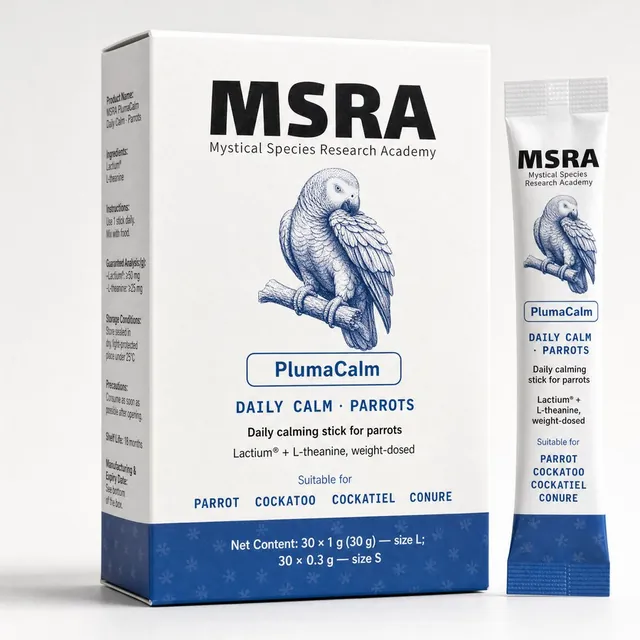
PlumaCalm
Daily calm and feather support, sprinkled on fresh food
A stick-pack powder for parrots built on insoluble fibre, the best-studied diet factor in feather pecking, plus L-tryptophan, alpha-casozepine and L-theanine. Sprinkled on damp food.
- Format
- Food sprinkle (stick pack)
- Pack
- 30 sticks × 1 g (size L) or × 0.3 g (size S)
- Price
- Announced at launch
No payment now. Join the waitlist and we email you once, when it is ready to ship.
Why we made it
Owners of greys, cockatoos, cockatiels and conures dealing with feather plucking, screaming or night frights have usually done the vet workup, added UV lighting and foraging toys, and paid month after month for supplements that did nothing. Dosing is its own battle: forcing powder into the beak of a bird that hates it, or adding it to drinking water, where small birds often fail to take in a reliable dose. The one calming product built on a studied mechanism has a single active, costs a lot and is often out of stock.
We started from the evidence, not the trend. The best-studied dietary lever for feather pecking in birds is insoluble fibre, so in PlumaCalm the carrier is the lead active, not filler. To it we add L-tryptophan, the serotonin precursor linked to pecking in hens, the same calming peptide as our cat and small-mammal lines, and L-theanine. It is pre-dosed in two sizes by bird weight, with millet, banana and anise cues for wary birds, and no added iron.
How we researched it
- Owner-problem phase: retailer listings, reviews and owner forums. Owners had tried everything; dosing failed in the beak or the water bowl; and one of Europe's largest pet retailers listed no bird calming product at all.
- Literature pass: our AI-powered research system cross-checked 71 PubMed-indexed papers; our team reviewed each claim. Pigeon GABA-A receptor subunits are 94.6-96.3% identical to reference sequences, so the peptide's target exists in birds, but no study has measured its absorption in any bird.
- A second, stricter pass found the laying-hen fibre trials and changed the formula: the carrier became the lead active, and a maltodextrin carrier was ruled out for good.
- Safety shaped the format. Small budgerigars have a thin margin against rodent safety data, so small birds get a separate, smaller stick. No added iron, calcium, vitamin D3, vitamin A or sodium; every anise lot is identity-tested to exclude star anise.
What's inside
- Insoluble fibre (lignocellulose)
- The lead active: more insoluble fibre cut severe feather pecking in controlled hen trials.
- L-tryptophan
- Serotonin precursor; in hens, low tryptophan is linked to more feather pecking.
- Alpha-casozepine (milk protein hydrolysate)
- Calming peptide shared with our cat and rabbit lines; its receptor target is conserved in birds.
- L-theanine
- Amino acid from tea leaves; a gentle second calming ingredient with a wide safety margin.
- DL-methionine and biotin
- Sulphur amino acid and vitamin the bird uses to build feather keratin.
- Millet, banana and anise
- Familiar tastes and smells so wary birds accept the powder on their food.
The evidence
- In laying hens fed diets with 3%, 6% or 9% insoluble fibre, severe feather pecking fell from 0.78 to 0.31 to 0.12 pecks per 30 minutes per hen (P<0.0001), plumage stayed better and laying performance was unchanged. Hens, not parrots. [1]
- In 1,600 laying hens fed from 16 to 50 weeks of age, a diet higher in insoluble fibre improved feather cover (P=0.016) and reduced rear-body pecking injuries (P=0.012). Hens, not parrots. [2]
- In growing bantams, adding L-tryptophan to the diet at 20 g/kg suppressed feather-pecking damage compared with no added tryptophan. Bantams, not parrots, and at a higher dietary level than our stick provides. [3]
- In 160 laying hens, acute tryptophan depletion induced gentle, repetitive feather pecking in all three genetic lines tested, linking the serotonin system to pecking. Hens; a mechanism study, not a supplement trial. [4]
Where the evidence stops
- No study has tested alpha-casozepine in any bird, and the fibre and tryptophan evidence comes from chickens, not parrots.
- PlumaCalm has not yet been tested in parrots. Our research calls for acceptance and small-bird tolerance studies before launch.
- Feather plucking often has medical causes, so see an avian vet first. Allow four to eight weeks; new feathers depend on the moult.
How to use it
Sprinkle one stick over damp chopped vegetables or soaked pellets, mix, and serve within 15 minutes. Not on dry seed or in water. Choose the stick size by bird weight.
Studies cited
- [1]Patt A, Halle I, et al. 2022. Influence of different dietary fibre contents in the diet on feather pecking, locomotor activity and performance of laying hens.British poultry science · PubMed 35543708
- [2]Aslam MA, Wall H, et al. 2026. Effects of low crude protein and high-fiber diets on production performance, egg quality, behavior, and integument condition in laying hens.Poultry science · PubMed 42476013 · Free full text
- [3]Savory CJ, Mann JS, et al. 1999. Incidence of pecking damage in growing bantams in relation to food form, group size, stocking density, dietary tryptophan concentration and dietary protein source.British poultry science · PubMed 10670667
- [4]Birkl P, Chow J, et al. 2019. Effects of Acute Tryptophan Depletion on Repetitive Behavior in Laying Hens.Frontiers in veterinary science · PubMed 31355217 · Free full text
These studies tested ingredients or similar products, often in other species, not this finished product.
PlumaCalm
Join the waitlist. No payment now, one email when it is ready to ship.